The month didn't decide which fundraising letters worked. The letter did.
A donor-funded nonprofit planned its fundraising letters around the calendar. I went through every main mailing on record, measured each one against its own month, and found what the strong letters had in common. Then I turned that into an assistant that asks questions and checks the draft instead of writing the letter in one go.
A theory about timing, tested against every letter
- The setting
- A donor-funded nonprofit that raises money with letters across the year. The working assumption was that the calendar decided which letters would do well.
- My part
- Solo, end to end: the performance analysis, a Claude Project that guides the writing, a web prototype, and a Claude skill for follow-up content.
- What changed
- Many of the strongest letters came from months the averages called weak. The patterns behind them became an assistant that asks before it drafts, and the first letter written with it was a success.
- Three takeaways
- Compare each result with its own baseline before you look for patterns. Check what you find against what the field already knows. Build an assistant that asks before it writes.
Two letters, the same month, opposite results
The analysis starts as a table: every main mailing on record, each result put on a common basis so a large mailing and a small one can be compared.
Two rows come from the same month. One letter did far better than that month's average. The other did far worse.
The calendar could not explain that.
Fundraising by the calendar hides the letters that beat it
Planning letters by the month is the obvious move, and the averages back it up: some months raise more than others. Stop there, and all the calendar gives you is a send date.
If you write these letters, what goes in them is the question you face every time, from the first line.
The prevailing theory was the calendar
By the averages, a few months looked like the reliable drivers of a strong result, and the planning followed the calendar.
It was a reasonable reading of the averages. It just couldn't explain why some letters in a weak month did far better than others in a strong one.
Measured against its own month, every letter told a different story
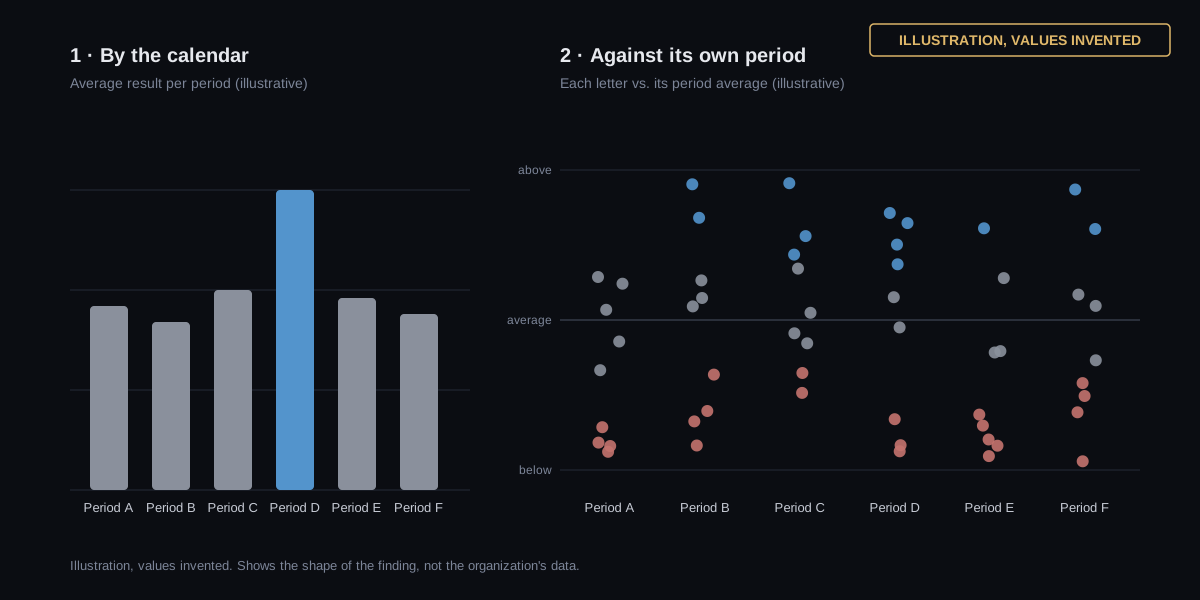
So I stopped comparing letters with each other and compared each one with the average for its own month, across every year on record. That changed the picture.
 View full size ↗
Illustration, values invented. It shows the shape of the finding, not the organization's data: by the calendar one period looks like the answer, but against its own period, letters in every period land well above and well below the average.
Many of the strongest letters came from months the averages called weak, and nearly every month had letters well above and well below its own average.
From seasonality to what made the difference, in five steps
The order mattered. Each step only made sense once the one before it had removed a false signal.
-
Normalize
Every mailing as its return per thousand letters sent, so mailings of different sizes could sit side by side.
-
Find the season
Monthly averages gave the calendar's own effect: some months simply raise more than others.
-
Take the season out
Each letter against its own month's average. Only now could a letter from a weak month be compared fairly with one from a strong month.
-
Sort into three bands
Average performers, outperformers and underperformers. The interesting work happens at the two ends.
-
Ask what made the difference
What the outperformers did that the others didn't, compared with the voice-and-tone analysis, the writing handbook and general fundraising best practice.
A concrete need beat an abstract mission
Once the season was out of the way, what separated the strong letters lined up with what fundraising practice has long held: a concrete, tangible need beats an abstract mission.
The last step was that check against general fundraising best practice. A pattern in a handful of letters is a hunch until something outside them backs it up, so only patterns the wider field also supports went into the assistant.
An assistant that asks before it writes
I put the findings together with the writing guidelines into a Claude Project. It doesn't write the letter in one shot. It guides the writer through the process, asks questions before it drafts, and checks things along the way. One of its seasonal rules says just that: the text decides, not the month.
I also built a web prototype for the same flow, and a Claude skill that carries a finished letter's message into follow-up content for other channels. All four pieces are mine: the analysis, the Claude Project, the prototype and the skill.
The first letter written with it was a success
No amounts or results from the organization are published here, the chart is an illustration with invented values, and the organization stays unnamed.
The first letter written with the assistant was a success. That it worked is all I'll claim for now.
Those two rows are still in the table
They no longer look like noise.
They are the reason the assistant asks its questions before it writes a word.
What to check before your next appeal
-
Compare each result with its own baseline before you look for patterns.
A calendar average hides the letters that beat their month. Measure each one against its season first, then sort into average, over and under.
-
Check what you find against what the field already knows.
Your own top performers are a small sample. Where they agree with general fundraising best practice, trust the pattern. Where they don't, test it before you build on it.
-
Build an assistant that asks before it writes.
Turn the findings and your writing guidelines into questions and checks, not a one-shot prompt. The person writing still decides what the letter says.
Without consistent results, there is nothing to analyze yet
If you have only a handful of mailings, or results you can't put on a common basis, the analysis has nothing to stand on. Start by recording results the same way every time; the assistant can wait.
Want to hear more?
- The assistant won't draft until it has asked its questions. If your writers could use that kind of constraint, measuring your own letters against their season is a good place for us to start.